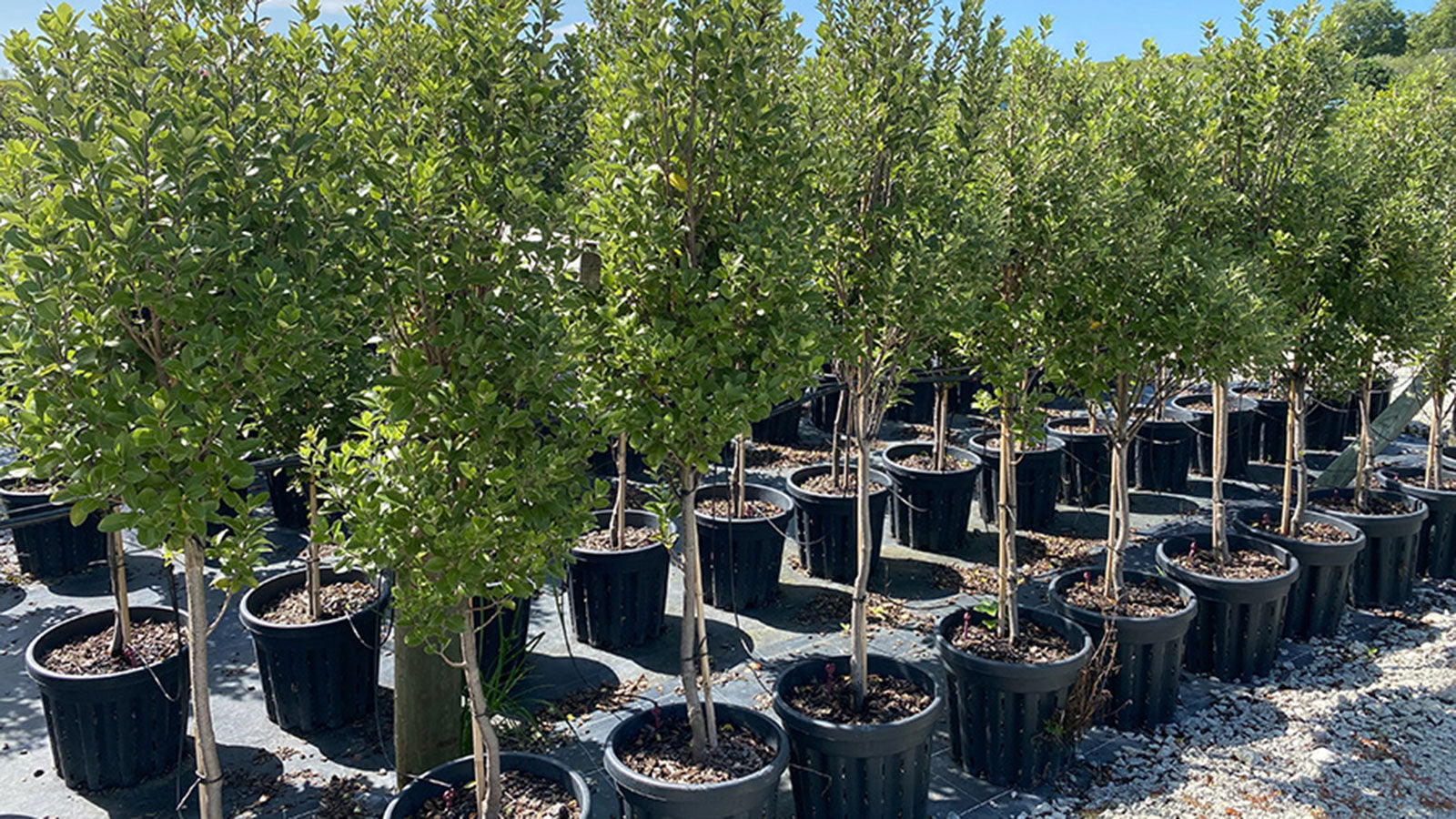


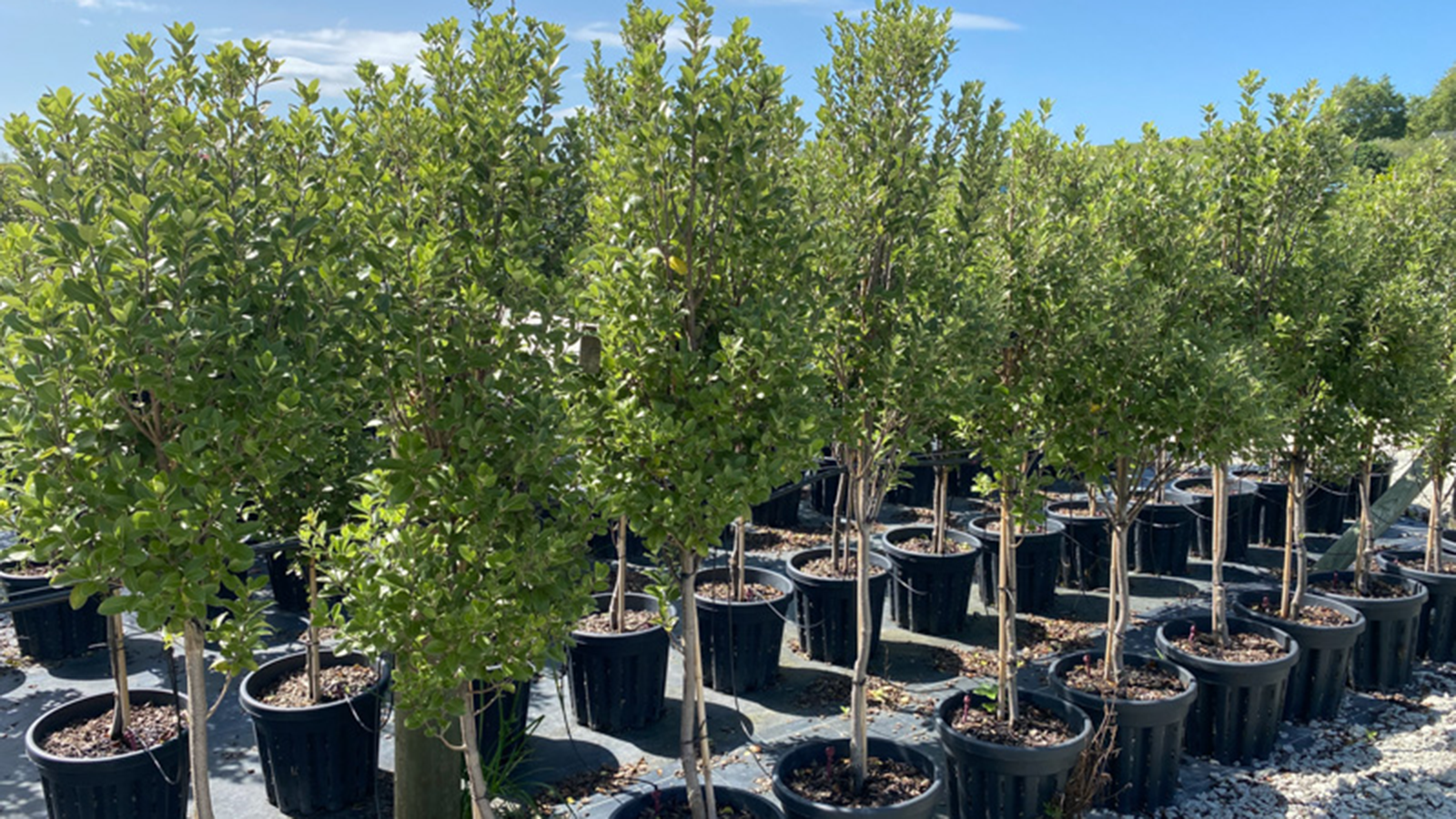

Take a tree break for your eyes to rest them, perhaps gently on some of our less flamboyant but hardier, faster growing, resilient, native Pittosporum species. The Pittosporum genus, which contains approximately two hundred species, is from the Pittosporaceae family. Some twenty-six species exist in New Zealand.
Takana carries just 5 of these - and we consider them important trees and shrubs.
Discover five resilient Pittosporum species stocked by Takana, perfect for shelter, screening and structure.
1. Haekaro ( Pittosporum umbellatum);
2. Roimata(P.cornifolium roimata)
3. Karo (P. crassifolium)
4. Kohuhu (P. tenuifolium); and
5. Tarata (P. eugenioides)
Haekaro Pittosporum umbellatum
Haekaro is an uncommon species ‘at risk’ in Aucklnd and Northland and thus currently dependent on survival for conservation assistance. It’s an attractive small tree up to 2m within ten years to a maximum of 4m,bearing flat smooth glossy green oval leaves and clusters of small pinkish or red flowers on long stalks with wide capsules that split into two to show the black sticky seed.
$180 – (1.4m) – 35L

Roimata (P.cornifolium)
This small, often epiphytic shrub grows up to 5m and is frequently found growing on other trees. It is an erect, multi-branched, small hardy tree forming an ovoid shape up to 2m within ten years to a maximum of 3m. P. cornifolium’s foliage is attractive and its smooth mid-green leaves grow in spiral formation. Pale yellowish, sometimes deep pink flowers appear in late winter to early spring and scent the air with an appealing sweet fragrance. Female blossoms are larger than males. Fruit capsules appear between May and August and may continue throughout the year. They split in two to reveal sticky seeds in orange pith which sticks to bird feathers and are naturally dispersed by them. Natural distribution is on the cliff sites and rocky ground of Northland & Poor Knights Islands.
It loves full sun, will tolerate marginal soils but absolutely flourishes on fertile, free-draining, soils. This species lends itself admirably to hedging, screen planting for landscaped situations, and as a specimen plant, or backdrop for smaller plants. Their smaller size, fragrance, and attractive blooms fit them perfectly for gardens and sheltered plantings. $180 – (1.4m) – 35L

Karo (P. crassifolium)
P. crassifolium is a hardy, tightly branched evergreen tree, with an attractive, generally conical form, and grows vigorously over ten years, up to a maximum 9m. Trunk and branches are dark brown, while Karo foliage is mid-green on the upper surface and whitish beneath. Leaves are and glossy with curled-back edges. karo is a sturdy species, tolerating strong wind, and salt spray, and when mature, light frost. I
t produces clusters of small, scented, dark crimson to purple flowers from August through November and fruits. This species’ natural range is on coastal shrublands and lowland forest from the far north, through to East Cape but has naturalised extensively as far as Norfolk, Stewart, and the Chatham Islands and in Wellington region. Karo makes fabulous hedging, excellent screens, shelter belts, and with its conspicuous red seed capsules, also makes an attractive specimen tree. $140 – (1.75m) – 45L

Kohuhu (P. tenuifolium)
Kohuhu (Pittosporum tenuifolium) is a densely-leafed very hardy evergreen growing to 4m within ten years to a maximum 10m. It is drought, wind, and frost tolerant and will grow on most soils. When the dark-coloured branchlets are broken, they emit a satisfying fragrance. Glossy, 2.5cm – 5cm pale-green leaves have wavy margins. Kohuhu blooms from October through December with deep purple, barely noticeable flowers which change colour to black over the season.
They produce intensely fragranced sweet nectar which attracts moths and other nocturnal flying insects. Fruit ripens in January through March, splitting into two or three seed-filled segments covered in clear sticky gum. Birds flock for nectar, fruit and seeds. P. tenuifolium thrives all over the country up to 900m with the exception of the South Island west of the divide. Kohuhu is an ideal specimen tree, makes a fabulous screen, and works well as background in mixed plantings. It also likes a good trim and hedges. $140 – (1.75m) – 35L

Tarata (P eugenioides)
Tarata is New Zealand’s tallest Pittosporum growing quickly to 6m within ten years, to a maximum 13m. A looser spreading shape topped by a well-formed rounded head develops as it gets older, and its sturdy trunk supports branches and foliage which grow from ground level. P. eugenioides is gynodioecious ( i.e. hermaphrodite and female plants may exist in the same population).
It is hardy and evergreen, with attractive foliage of glossy, pale yellow-green, leaves with wavy margins. Greenish-yellow strongly honey-scented flowers appear in clusters from October to December at branch tips. Fruiting with small smooth 2-3-segmented capsules carrying many seeds to January. This tree tolerates mild drought and less fertile soils. Its natural range is on coastal forest and montane environments throughout the country with the exception of Stewart Island, and limited scarce presence in Westland. An eye-catching specimen tree, as well as a background plant, Tarata also makes excellent hedging.
$140- (1.75m) - 35L

More sticky-beak Pittosporum moments
- The name, Pittosporum is translated loosely from Greek as pitch-seeded, and relates to the clear pitch-like sticky goo inside the typically segmented seed cases of Pittosporum species.
- In the natural environment, Pittosporum species contribute to soil stability and fertility through their typically extensive root systems and leaf litter.
- Most Pittosporum species are magnets for insects and birds and all share the same seed-dispersal system through the sticky mass inside seed capsules which birds and moths pick up, stuck to their feathers and wings along with the seeds.
- Tarata,P eugenioides, and Kohuhu P. tenuifolium were both well utilised by Maori, and still are, for traditional carving and modern woodworking.
- Substantially–sized Pittosporum species produce good quality, close-grained all-purpose timber.
- Those with access claim it as an excellent firewood.
- Many Pittosporum species produce perfumed flowers, very few of which might be termed flamboyant, though most species’ blossoms are barely noticeable. However most Pittosporum species have striking foliage which makes them very attractive in a landscape.